Lemmon Society Magazine •Issue 002•
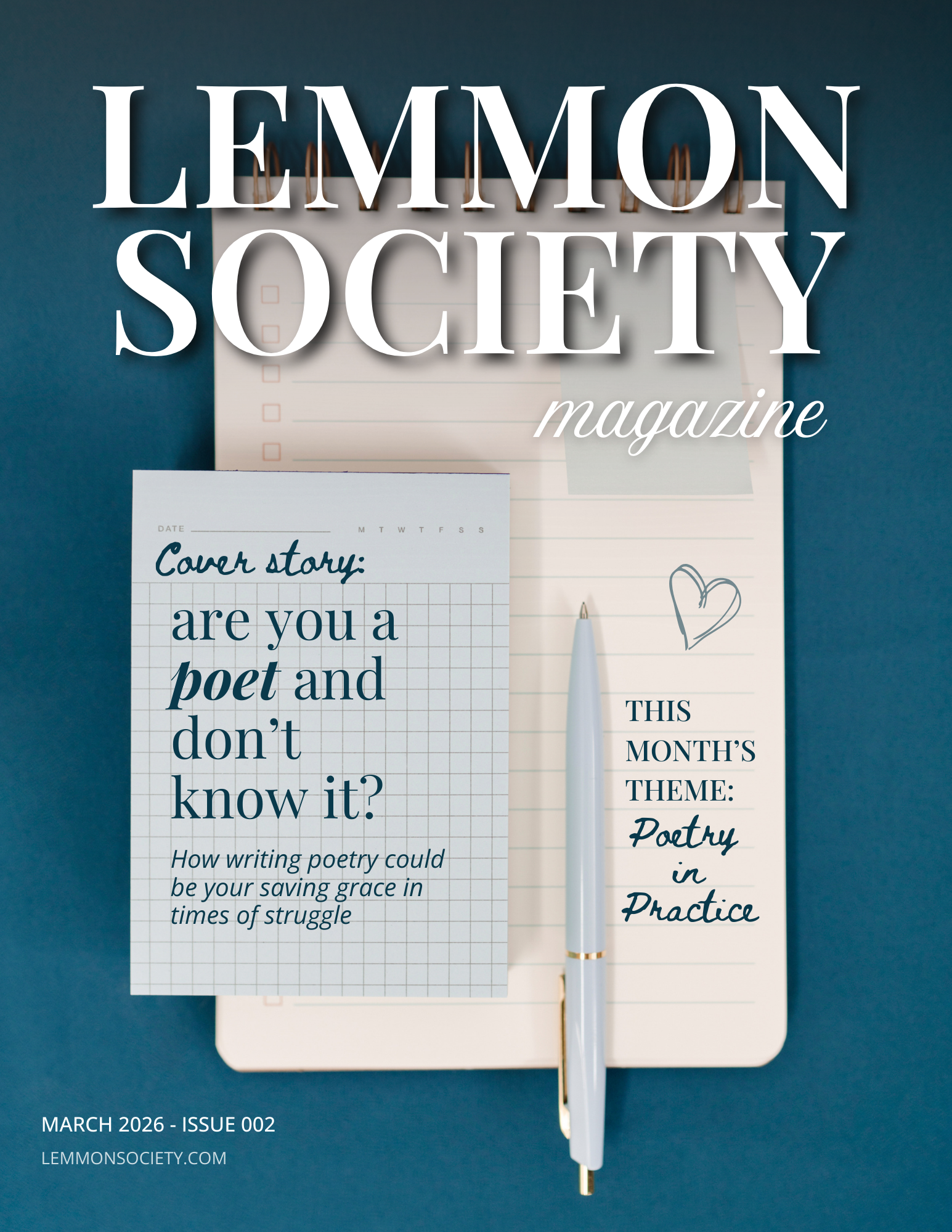
March 2026 - Issue 002
From the Editor

Jessica Lemmon is a #1 Bestselling Author, Writing Coach and the Founder of The Lemmon Society.
Welcome to Issue 002 of Lemmon Society Magazine!
This month, we’re focusing on the theme of Poetry in Practice. Practice is a word that’s often misunderstood. As if we’re on the road to the Land of Skill, but haven’t quite made it to our destination yet. That while we are practicing, we are also waiting for the illusive “they” to finally label us as experts.
For our purposes, let’s consider practice to be more of a ritual. After all, doctors are “practicing” medicine, aren’t they? I’ve yet to hear one say, “I’m not good at it yet, but I’m getting there!”
So what does it look like to practice a skill you’ve dabbled in, or maybe one you’ve never tried?
Poetry can feel intimidating if you compare your first draft to someone else’s polished, perfect prose. But that’s not a good reason not to attempt poetry writing yourself. It doesn’t have to be good to feel good. (Someone put that on a bumper sticker.)
The title of this month’s cover story was intentional. This saying has been floating around my family for a long time. Whenever anyone said something that accidentally rhymed, you would inevitably hear, “You’re a poet and don’t know it.”
And if that someone was my dad, he would add, “Better a poet than a go-at.🐐”
In the spirit of not taking ourselves (or our prose) too seriously during a time when everything around us feels very serious indeed, we’re exploring writing poetry without rules. The entire point of picking up your pen is to express yourself—whether the words rhyme or not.
Let go of the idea of perfect and live in the practice. Give your inner self a safe space to express themselves, and just freaking go for it. You never know what you’ll learn about yourself in the process.
Each month, Lemmon Society Magazine shares the full-length cover story that highlights what’s unfolding beyond inside a membership of the same name. Be sure to check out the invitation to join us at the bottom of this page.
Grab your warm mug of tea or coffee, your favorite fountain pen, and your moodiest music. Let’s write!
Jessica Lemmon
Editor, Lemmon Society Magazine
Book Rec of the Month: Lyrical Love
I consider songs forms of poetry, so I can’t help featuring a fan favorite that even I can’t resist reading again and again.
Asher Knight is a rock star like no other, and Gloria has been through hell and back with him. Now, Evergreen Cove’s resident rock god has a 3-year-old son. The boy shows up out of nowhere making Asher an instadad, while independent, no-strings-attached Gloria is trying her damndest to avoid heartbreak with Asher at all costs.
Grab your tissues, and dust your keeper shelves. There’s no couple quite like these two.
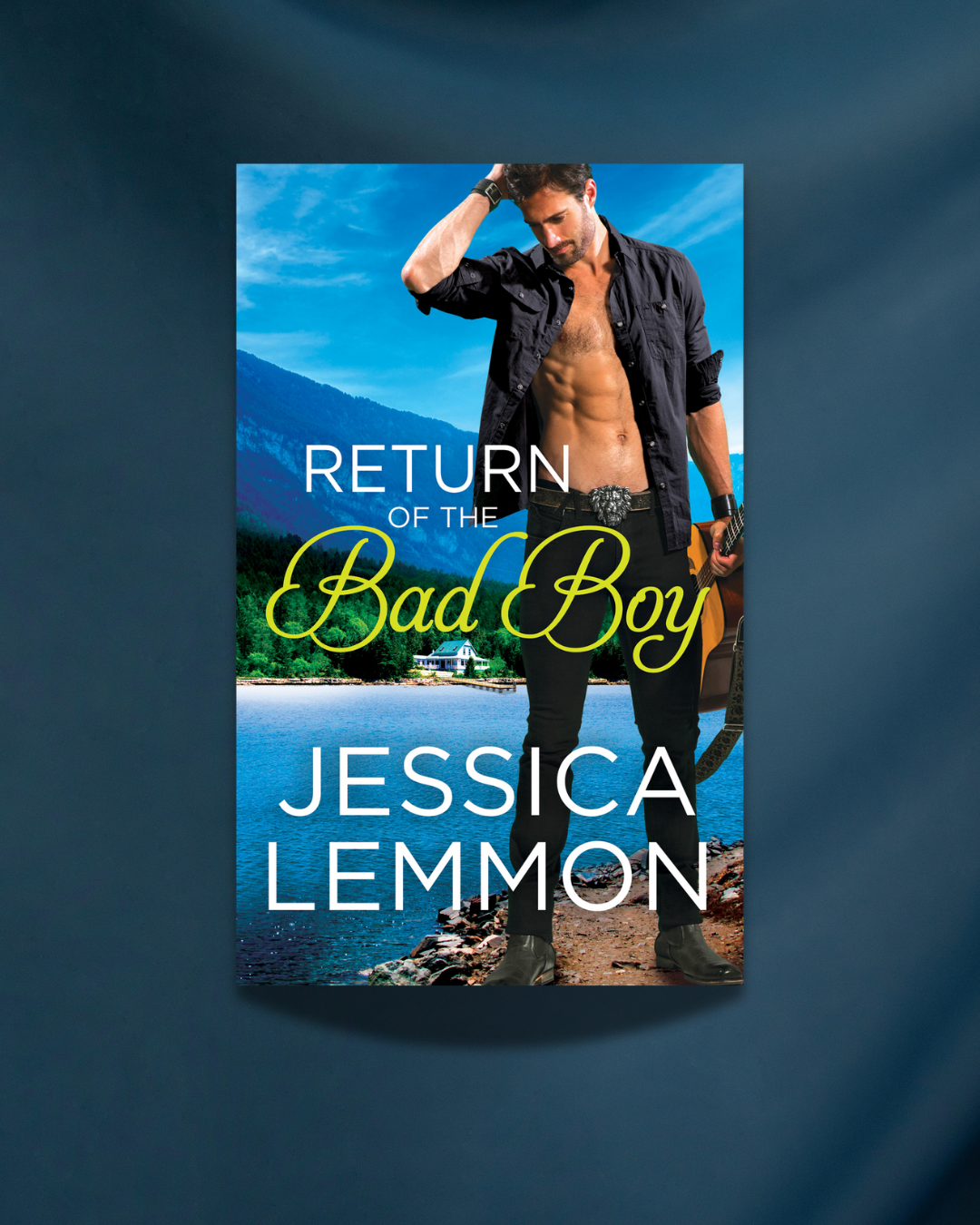
Return of the Bad Boy, a second-chance rockstar romance novel written by Jessica Lemmon.
Cover Story: Are you a poet and don’t know it?
How writing poetry could be your saving grace in times of struggle.

In school, I loved English and literature classes apart from one itty-bitty, teeny-tiny practice…
When instructors would ask us to pick apart the meaning or theme of the work we were studying. Dissecting a poem, for me, was about as appetizing as dissecting a dead rabbit. (And, yes, I did dissect a dead rabbit in my senior year. It wasn’t pleasant.)
As an intuitive, a creative, and someone who feels her way through life, I enjoyed consuming poetry (and songs and books) for how they made me feel when I was reading them. If it resonated, it did. And if it fell flat, oh well. I didn’t really bother asking why.
An adult now, I know there is a deep and complex web of meaning inside of poems, and that they are written with careful intent. My sister-in-law is a published poet, and her poems are beautiful and brave, raw and real. She writes poetry in the same way a friend of mine writes his comedy shows. With careful precision.
As a writer, I understand that sort of precision. The feeling that there’s always a right word, and sometimes we have to go through hell and back to find it. Or at least a couple of rough drafts.
But what about those of us who don’t plan on taking to the stage to recite our musings and receive laughter or finger-snaps as our reward? Does poetry only belong to the experts? In the classroom? To people who know the difference between iambic pentameter and trochaic tetrameter?
Is there a right way to do it, and should you figure out what it is before you try?
How Writing Poetry Helped Me
I’ve written novels, song lyrics, poetry, essays, and short stories. I’ve penned journal pages, planner entries, dear-diary diatribes. Each way of writing has its own benefit to the writer, and to the reader (even if it’s only you it’s shared with.)
When I was a senior in high school, with a bedroom festooned in red shag carpeting (out of style even for the 90s), I wrote a lot of poetry. In the years that followed, when I moved into an apartment and took a server job making so little money I don’t know why I bothered, I wrote a lot more. I had a lot of big feelings about the men (boys?), life, and my body.
Writing my thoughts, fears, and dreams down wasn’t about sharing my feelings with anyone, so I didn’t bother to follow any rules. I simply wrote. I wrote about my pain and heartbreak, about my rage and disgust. And in one work that I'm still fiercely proud of, about my beloved grandfather after he passed.
I wrote without censorship. I dropped F-bombs and told the a-hole that lied to me exactly what I thought of him. I wrote through feeling misunderstood. I wrote through feeling used. And when I met my husband, I wrote about love. Love and joy and about finding my forever.
I’ve since found those handwritten and printed pages and wondered if I should publish them. But in the end, I’m not sure they would help anyone as much as they helped me. Through that writing (often to the music of Pearl Jam, Alanis Morissette, or Jewel) I navigated the choppy and strange waters of teenager through my early twenties.
Poetry, for me, has and always been about self-expression in times of overwhelming emotion. I loved writing short form for the immediate satisfaction—the gut-punch feeling brought about by a few meaningful words. Fast and furious scribbling the next line and then the next, one emotional bomb-drop after another.
I remember writing and rewriting and rewriting a poem about a vampire when I was younger. Interview with the Vampire became an obsession for me. And I loved the mystery and the romance of it all—I still remember the opening lines that live in my head like a song I’ve heard a thousand times.
Someday, I’ll write a vampire romance and put them in the front of the book.
How Writing Poetry Could Help You
If you’re going through a hard time now—if the world seems like it’s burning around you, if your heart is breaking over a man or a woman or a dog or a job, if your mood swings have mood swings thanks to PMS or perimenopause or, if you’re at a certain age, both, I encourage you to pick up a pen.
Put on your monocle (any Heathers fans out there?), scribble up a notebook. Or (to make another Winona Ryder reference) start with “I am alone. I am utterly alone.”
You’ve heard me say that joy is always available if we choose to see it. It is, but sometimes you have to climb out of the muck to find it. In this case, writing your feelings down gives them validity. They don’t have to knock around in your head any longer, they get to live on that sheet of paper. Forever, or until you burn it. (Safely, please.)
Here are a few rules for your writing:
There are no rules. You don’t need structure, rhyming, or rhythm.
A few honest lines—F-bombs encouraged!—can defuse intense emotions in the moment
This kind of writing is meant to be private and pressure-free. Misspell words, write in crayon, put it on a blackboard and erase it immediately.
Take up space. Write big and bold. Maybe your poem has 10 words that fill the entire page.
Or maybe your delicate handwriting only fills a few lines in the upper right-hand corner.
When you feel it’s complete, it is complete.
You don’t need permission to mark up your nearest notebook with your thoughts, but if you weren’t sure if you should attempt writing “real” poetry, I hope this changed your mind.
You don’t even have to call it poetry, or show it to anyone—hell, it doesn’t have to be any good. Allow it to simply be.
In a world that is always asking us to explain ourselves, we often feel as if we have to justify our feelings, but guess what? You don’t have to justify them. Not to me, not to you, not to anyone. Picking up a pen in private can become a radical act. Because the more you get to know who you are, what you believe, and what you care outside of the chatter online, the more powerful you become.
And good-hearted people with power is exactly what this world needs right now. Can you think of a better way to live the remainder of your one precious, beautiful life?
I can’t.
♡
Jessica Lemmon is a former job-hopper who resides in Ohio with her husband and rescue dogs. She holds a degree in graphic design currently gathering dust in an impressive frame. When she’s not writing emotionally-charged stories, she spends her time drawing, drinking coffee, and laughing with friends. Her motto is Read for Fun, and she believes we should all do more of what makes us happy. Learn more here.
This month’s full issue is available inside The Lemmon Society membership. Join today.
You're too busy to give your next book idea the space to grow. Writing groups have left you feeling drained by the complaints and industry doom, and you're still looking for advice you can trust. I see you. There's a difference between wanting to write a book and becoming the woman who does. Every Wednesday, we write together in a sunny, negativity-free space, with monthly card pulls and a live gathering where you can ask me anything. Writing is supposed to be fun, and inside TLS, it is. 🍋
Current Members
👇
STORY NOTES - Step behind the curtain to learn how Jessica Lemmon crafts unforgettable characters. Be inspired and read behind-the-scenes secrets that aren’t available anywhere else.
THE DROP - Our cover story in practice!
Poetry prompts that you can use as a jumping-off point for a lyrical lay of the land
Jessica’s audio performance of a private, heartfelt poem from her own collection
A mystical, magical tarot/oracle card reading revealing the energies surrounding us
BOOK CLUB - Read along at your own pace, comment, or lurk—this is your space to chat about our pick of the month.
PEP TALKS - These audio recordings are short, sweet, and packed with encouragement when you need them most. Download to have it on the go, or listen when you log on.
LIVE CALL - A live Zoom gathering touching on a variety of topics: writing craft, marketing, your author identity, and more. The floor is always open for questions, on video or off.
* In addition to what’s listed here, Members have access to a full catalog of past posts, exclusive stories, and more.