How to Build a Writer’s Mindset That Helps You Finish Your Book

Writing a book is a process. A long one, for most of us.
You start with an idea, or characters. You build scenes involving both. You develop your outline, maybe even create a writing ritual. You design your cozy writing space so that you can let all that lovely creativity flow.
Then, while writing chapter 7 (or 9 or 13…), you reach a point where that sparkly book idea is less sparkly and feels more like hard work.
Womp.
And suddenly:
The middle be messy
A paragraph is way harder to write than it should be
That scene you couldn’t wait to get to is boring AF
Then your brain drips poison into your ear, whispering things like:
This book is bad.
I should start over.
Maybe writing isn’t for me
That’s when it’s time to check your mindset—which matters as much (more?!) than any #writetip you’ve ever read online.
Finishing a book requires you firing on all cylinders, my friend. You have to return to the page again and again over a period of weeks or months, and in order to do that without feeling like you’re dying, you’re going to want to feel good about sitting in your chair and placing your fingers on your keyboard.
That’s a muscle you gotta build.
And after writing nearly 50 books, I can tell you, I am still building it.
But it’s so much easier than it used to be.
How to cultivate a writer’s mindset:
Having a writer’s mindset is all about challenging the way you think about yourself, your book, and your creative process. If these things are aligned (you know you’re a great writer, your book is coming along beautifully, and your creative process is easy to plug into), that will affect how eager you are to start your writing day.
A healthy mindset could be the difference between:
“Why am I having such a hard time with this scene? I suck at this.”
or
“This scene is challenging. Luckily, I am a great writer and I understand that this is just a process I’ll soon be on the other side of.”
And, for the record, having a fantastic mindset doesn’t mean you never doubt yourself. Every writer has days that feel hard, doubts that creep in, and moments where concentration is at an ATL. (To quote Bo Burnham, “That stands for All Time Low, not Atlanta.”)
But when you’re in what I like to call “the wobble”, returning to your positive affirmations (I’m a great writer, of course I can handle this) can be a lifeline.
Writing a book is more than writing tips
Writing tips are everywhere.
Open Instagram, Pinterest, TikTok, or YouTube and you will find writers (including me!) telling you all about plot structure, character arcs, dialogue, outlining, editing a first draft, tropes, and how to properly market your book.
I love giving good writing advice as much as I love hearing it. After all, I have built a career out of writing romance novels, so I have learned plenty about craft and publishing over the years.
But all of the helpful process advice in the world won’t be enough to help you finish you book. That is the doing part, and to focus solely on “doing” we’re missing a huge piece of the puzzle.
The being part.
The real challenge to finish a book isn’t story structure alone. You also have to ask yourself:
Am I willing to show up as much at it takes to finish this book?
Am I able to shake off not hitting my word count goal and not beat myself up?
Am I able to let the first draft be shitty, rather than trying to make perfection out of the first round?
That’s the mindset—the being—work that we must do each and every day.
I’m going to show you 4 ways to begin that practice.
1. Stop feeling like you’re failing
You’re not f-ing it up. You’re just going through the process of writing.

Don’t panic. A simple “I got this” does the job.
The messy middle is called the messy middle for a reason!
At the middle point, you know your characters better which is a great thing, except that you didn’t write them as rich and nuanced in the opening chapters. In fact, you probably info-dumped your way through the first two or three chapters.
Well.
Shit. 💩
Don't panic. This is where your mindset training comes in. There is nothing wrong with your book, even though there are parts you would like to improve.
I always recommend to keep moving forward rather than go back and try to fix the beginning or attempting to smooth your way to where you left off.
Doing that can cause a loss in momentum. Simply trust that you will have the chance to go over it after you finish the book. That first self-edit pass is where you can adjust and shift the parts that went off the rails.
Keep your momentum. And keep repeating any affirmation that helps you keep going.
“I got this” is simple, and does the job.
2. Build a writing routine
I am a big believer in writing rituals and beautiful creative spaces, but you don’t have to have the perfect physical space to create the routine you need.
You’ve heard me say that sometimes I sit at my desk in my pink and gray office, other times on the recliner with my laptop. Some days I’m outside on the patio or at the kitchen table by the sliding doors overlooking the backyard. On the rare occasion I am at Starbucks, enjoying the piped-in music and a Caffe Soy Misto (with Pike Place, please).
Finding a routine that fits your life can be a simple as knowing your daily word count goal. I know writers who measure by number of pages written. I sometimes use a timer. Listen to a playlist. Other times it’s silence and the rain outside my widow.
Are you a morning person or an evening person? Can you write in 15-minute bursts, or do you need to clear an hour-long block so that you can concentrate?
“Are you a morning person or an evening person? Can you write in 15-minute bursts, or do you need to clear an hour-long block so that you can concentrate?”
Create enough structure so your brain recognizes that when the usual suspects show up (Mrs. Peacock in the library with the laptop…), it’s time to focus on the writing goal.
Most days, my writing routine is simply:
Coffee
Laptop
Notebook
Then I read the words I wrote during the last writing day, do a quick edit to refresh myself as to where I left off, decide where I’m going next and then…I WRITE.
Your writing routine doesn’t have to be precious or perfect.
It just has to work for you.
3. Speak success over yourself
The way you speak to yourself matters. After all, our cells have ears. We speak health, we get health.
In that same vein, how you speak to yourself while writing, or before or after, makes a difference on your process as well. One of the things I started noticing about myself after a writing session is that I rarely believe I’ve done enough.
My inner monologue says things like:
I’m behind
I should have started earlier
What if I don’t make my deadline?
Yours might say any number of things, like:
“Punishing yourself will not speed up the process.”
This is taking forever. Why am I so slow?
I cannot concentrate.
I bet [insert author name here] never has these problems
Um, yeah. She probably does.
What we want to do is shift out of these thoughts, which are born of lack, and speak strength and success over ourselves instead.
Maybe try these:
Just because I feel this way doesn’t mean I didn’t make progress
We’ll get ‘em tomorrow
I just need a good night’s sleep. I’ll wake up with a solution to this plot knot by morning
Each writing session is making me a better writer
I did my best
A helpful reminder: Punishing yourself will not speed up the process.
4. Find the support + encouragement you need to be successful
Have you heard the saying, “Alone you can go fast, but with others, you can go far”?
Community helps a ton when navigating doubts and fears. But you have to find the right community. There are plenty of groups online that chat about writing, but I noticed they tend to skew negative.
No thanks.
Yes, we have to acknowledge our struggles, but let’s not build a tent and camp out there.
You are the reason why I created The Lemmon Society.
Because writing a book can be a lonely journey, especially when you are trying to keep your plot straight, navigating plot twists you never saw coming, or trying to encourage yourself to show up for the weeks or months (years?!) it takes to finish your first draft.
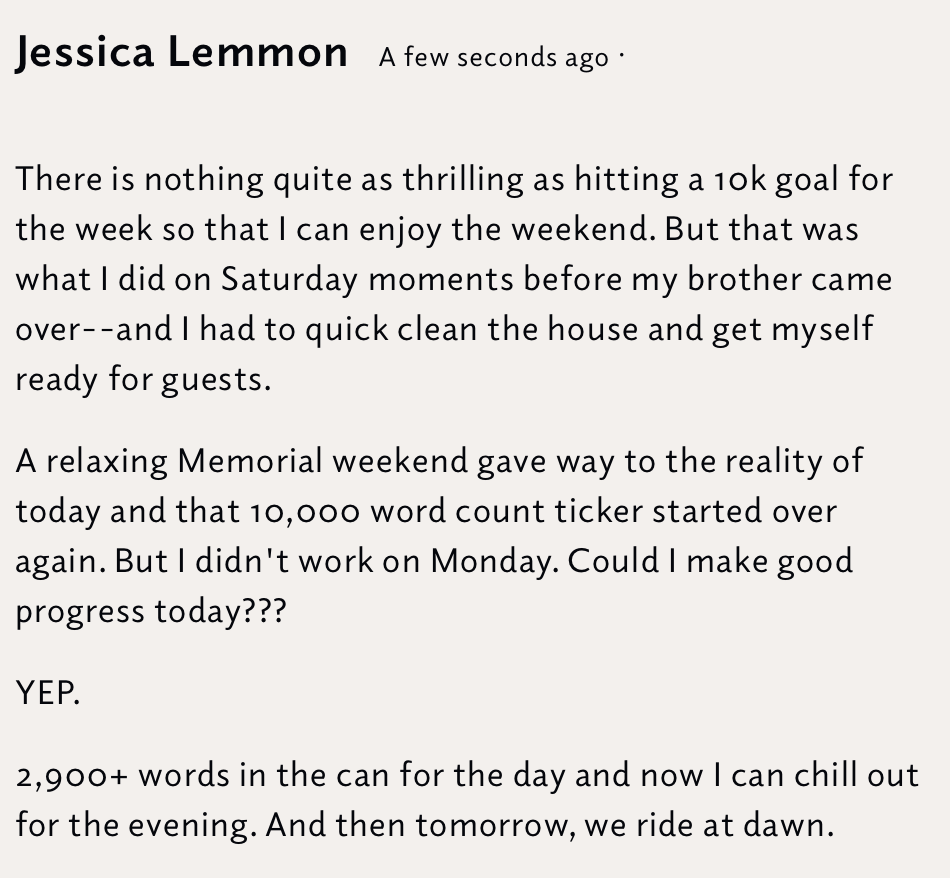
A screen shot from one of my entries in the Lounge
For example, I show up in the Lounge section of TLS often. Why? To log my progress, lick my wounds if I had a challenging day, or to check in on everyone else. Being encouraged and giving encouragement are huge for me!
Supported writers finish books.
So don’t miss the chance to show up and be supported in the ways that help you most:
Logging your progress in the Lounge
Showing up on a live call to learn and ask me questions
Listening to a pep talk audio
Taking a full workshop on “human being vs. human doing: ease over exhaustion”
The writer’s mindset shift that changes everything is just a click away…
If writing hasn’t been “easy” ask yourself how it could be.
Do you need a routine? A schedule? Support and encouragement?
If it’s the latter, I invite you to join us inside the Lemmon Society.
We talk about the practical side of writing, also. But I will venture to guess that it’s the being—the mindset side—that will nurture you more.
Craft matters. Process matters.
But so does encouragement, identity, and having a place to show up when the draft feels long.
If you want to keep writing, keep believing, and finish the book you started, join today and...
Let’s write!
xo,
Jessica 🍋
Membership Info:

You're too busy to give your next book idea the space to grow. Writing groups have left you feeling drained by the complaints and industry doom, and you're still looking for advice you can trust. I see you. There's a difference between wanting to write a book and becoming the woman who does. Every Wednesday, we write together in a sunny, negativity-free space, with monthly card pulls and a live gathering where you can ask me anything. Writing is supposed to be fun, and inside TLS, it is. 🍋